
The 9 Questions to Ask Before Taking the Leap of Faith Into AI in Trade Finance
It All Begins Here
Author: Venkat Ramaswamy
Transformation Success Partner & Founder @ Atocha Consulting

AI Enablement doesn’t have to be a Leap of Faith
Make a confident leap in Trade & Supply Chain Finance (and Banking in general) by asking these questions upfront.
If you have spent more than five minutes in a modern banking boardroom, you have likely survived an AI presentation that felt suspiciously like a sci-fi pitch deck. Someone throws around terms like autonomous orchestration, cognitive reasoning, or hyper-personalization, while a slide of a glowing blue brain spins gracefully in the background. Everyone nods. Heads tilt thoughtfully.
Then, the meeting ends, everyone goes back to pushing manual PDFs around, and nothing changes.
Sales cycles with banks feel endless not because bankers are inherently cautious, but because institutional gravity is heavy. Nowhere is this truer than in Trade Finance—a multi-trillion-dollar engine built on paper bills of lading, manual compliance checks, letters of credit (LCs), and a healthy, deeply ingrained fear of regulatory fines. In trade finance, a "leap of faith" into AI usually means a fast track to a compliance disaster if you don't know where you are landing.
Before you greenlight an enterprise AI initiative, drop the vendor hype and put away the glossy feature lists. You need to answer 9 fundamental questions.
The brilliant part about these 9 questions is their architecture: Question 1 establishes your destination (Ambition), and the remaining eight questions answer what has to be true for that ambition to become real (Foundation, Execution, and Scaling).
Group 1: Establishing the Ambition
1. What is our "AI Thesis" for Trade Finance? (Strategy)
The Core Focus: Value vs. Hype.
The Reality: Most bank AI initiatives fail because they start with a tool looking for a problem. "We bought this cool LLM license, now where do we apply it?" That is backwards.
Trade Finance Context: Your AI thesis cannot be "we want to use AI to look modern." It needs to be precise. For instance: “We are deploying AI orchestration to compress trade document verification cycles from days to minutes while maintaining zero regulatory tolerance for sanctions breaches.” If you cannot write your thesis in one clear sentence that your risk officer and head of product both agree on, stop right there. You don’t have a strategy; you have a subscription.
Group 2: What Has to Be True? (The Reality Check)
Once you know where you are going, you must answer what has to be true operationally, culturally, and technically for that ambition to survive contact with reality.
2. What are our "Guardrails as Enablers"? (Foundation)
The Core Focus: Compliance, ethics, and explainability.
The Reality: Bankers often treat compliance and AI innovation as mortal enemies. In reality, guardrails are the only reason you are allowed to drive fast. If an AI model rejects a Letter of Credit, it cannot just say, "Because the vibe feels off."
Trade Finance Context: You must define your explainability thresholds upfront. If you are using probabilistic models to extract data from a messy commercial invoice, you need deterministic policy gates behind them to ensure compliance with UCP 600 rules and local sanctions lists.
3. How do we mobilize an AI-first Operating Model? (Foundation)
The Core Focus: The "Who, How, and Where" of decision-making.
The Reality: Inserting 2026 AI technology into a 1996 siloed organizational structure is like strapping a jet engine to a horse-drawn carriage. Something is going to break, and it won't be the jet engine.
Trade Finance Context: Who owns an AI-driven exception? If an optical character recognition (OCR) tool misreads a shipping port code, does it route back to the trade operations desk, or does compliance handle it? If decision rights are murky, the software stalls and the staff reverts to manual email chains.
4. What are the foundational "Pre-conditions" for success? (Foundation)
The Core Focus: Data quality, tech stack/infrastructure, and process mapping.
The Reality: AI feeds on data. If your trade data is trapped in unformatted legacy PDFs, siloed core banking mainframes, and individual loan officers' local desktop folders, your AI is essentially starving.
Trade Finance Context: Before launching a complex trade finance copilot, look at your historical trade transactions. Are your swift messages, electronic bills of lading, and amendments cleanly mapped, or are they a digital landfill? Clean your data pipes before you turn on the pump.
5. Which use cases yield the highest "Value-to-Feasibility" ratio? (Execution)
The Core Focus: The 2x2 matrix of prioritization.
The Reality: Trying to fix the entire end-to-end trade lifecycle on day one is a fantastic way to burn millions of dollars and exhaust your internal champions.
Trade Finance Context: Pick your battles. Trying to fully automate end-to-end syndicated loans with generative AI on day one is a low-feasibility nightmare. Automating the ingestion and preliminary discrepancy checking of incoming bills of lading against commercial invoices? High value, high feasibility. Start where the friction is heavy and the data is digitized.
6. What are the "Leading Indicators" of value and risk? (Execution)
The Core Focus: Defining KPIs for the Proof of Concept (PoC).
The Reality: Too many banks measure AI pilots by vanity metrics like "number of prompts run" or "employee satisfaction scores."
Trade Finance Context: Measure the metrics that matter to the P&L and risk committee. What is your STP (Straight-Through Processing) rate baseline? How much did manual touch-time drop per transaction? What is the false-positive rate on compliance flags? If your leading indicators don't track operational velocity and risk reduction, your PoC is just an expensive science experiment.
7. How do we evolve our workforce from operators to "AI-enabled experts"? (Scaling)
The Core Focus: Mindset shift for scaling, and avoiding the dreaded "shelfware."
The Reality: The biggest threat to bank tech adoption isn't technology failure; it's employee quiet-quitting because they don't trust the tool or fear it's coming for their jobs.
Trade Finance Context: Trade finance specialists are seasoned professionals who take pride in spotting a forged signature or a subtle document discrepancy. Frame AI not as their replacement, but as their junior trade analyst who handles the tedious 80% of data crunching so the expert can focus on complex risk judgment.
8. How do we institutionalize AI into our core business process? (Scaling)
The Core Focus: Transitioning from isolated "projects" to permanent "capabilities."
The Reality: Many banks run brilliant 12-week AI pilots, celebrate the success with cake, and then watch the initiative quietly die because it was never baked into core operations or budget lines.
Trade Finance Context: If your AI solution lives on a separate innovation sandbox server, it hasn't changed your bank. It needs to be embedded directly into your core trade processing platforms, with permanent maintenance, continuous monitoring, and dedicated operational support.
9. How do we build the "Feedback Loop" to keep evolving? (Scaling)
The Core Focus: Continuous learning and model drift.
The Reality: Markets change, trade routes shift, compliance regulations update overnight, and models drift. An AI deployment that is accurate today can become a liability next year if it doesn't learn from its exceptions.
Trade Finance Context: Build a structured "human-in-the-loop" feedback loop. Every time a trade specialist overrides an AI recommendation or catches an error, that correction must be systematically fed back into the training loops and rule dictionaries. Your AI should get smarter every time a human corrects it.
Summary: The Cost of Skipping the Questions
If you look closely at these nine questions, you'll notice a running theme: The technology is rarely the bottleneck.
Bank tech sales cycles aren't long because vendors write bad code; they are long because banks try to buy an Acceleration stage solution when they are still stuck struggling through their Foundation stage.
So, before you sign that next multi-year enterprise software contract, run your leadership team through this list. If you can answer these nine questions honestly, you won't just leap into AI; you'll actually stick the landing. And who knows? You might even close the deal before your oldest child starts middle school.

How AI Transformation Can Solve Trade Finance’s Margin and Growth Puzzles at One Go!
It All Begins Here
Author: Venkat Ramaswamy
Transformation Success Partner & Founder @ Atocha Consulting

Efficiency self-funds Growth
There is a popular phrase in my mother tongue (Tamil): “Orey kallula rendu maanga”. This translates into “Strike two mangoes with a single stone”. Yes, this is the vegan version of “Strike two birds with one stone”.
Artificial intelligence is a paradigm shift of that magnitude for trade finance. Used correctly, it can strike two major goals at once: operational efficiency and business growth.
Here is the secret formula upfront, saving you a million-dollar consulting fee: Right AI investments significantly improve operational efficiency, which in turn self-funds growth. Put in practical terms: What if you can transfer 50% of current processing steps to AI so your teams gain the bandwidth to handle twice the transaction volume without adding headcount?
It sounds ambitious, but it is entirely achievable. There is a method to the madness.
The Fundamental Thinking Shift
Real transformation starts with a shift in mindset. For years, banking operations have relied on a human-led and machine-supported model. A human does the heavy lifting, and software acts as a simple utility.
Moving forward, banks must pivot to a machine-led, human-supervised model. Success depends entirely on how well an institution adopts this mindset and aligns its governance and culture to these new ways of working.
If you start your AI journey by asking, "Where can we implement AI?", you are bound to fail. Doing so puts AI on the exact same trajectory as blockchain solutions looking for a problem—a hammer looking for a nail.
Instead, a better way to start the journey is by asking two operational questions:
1. Where are our margins compressed today? This uncovers revenue leaks from friction, inefficiencies, manual workarounds, handoffs, SLA breaches, and customer complaints in daily operations.
2. What growth opportunities are we missing today? What prevents the team from capturing new market segments or launching new products?
Solving Margin Compression
Margin compression in trade finance rarely comes from bad market rates. It comes from the high cost of manual operations and friction. To fix this, look at where AI has a clear right to win. We can break operational gaps down into four layers:
· Prerequisite Gaps: Siloed systems, lack of APIs, messy data policies, and process chaos.
· AI-Automation: Routine tasks that can be automated confidently using machine intelligence.
· AI-Augmentation: Complex tasks where bankers perform smarter work enabled by co-pilot tools.
· AI-First Design: Areas with a complete capability gap where intelligent systems solve problems from scratch under strict compliance guardrails.
The following matrix maps these layers directly to common customer pain points:
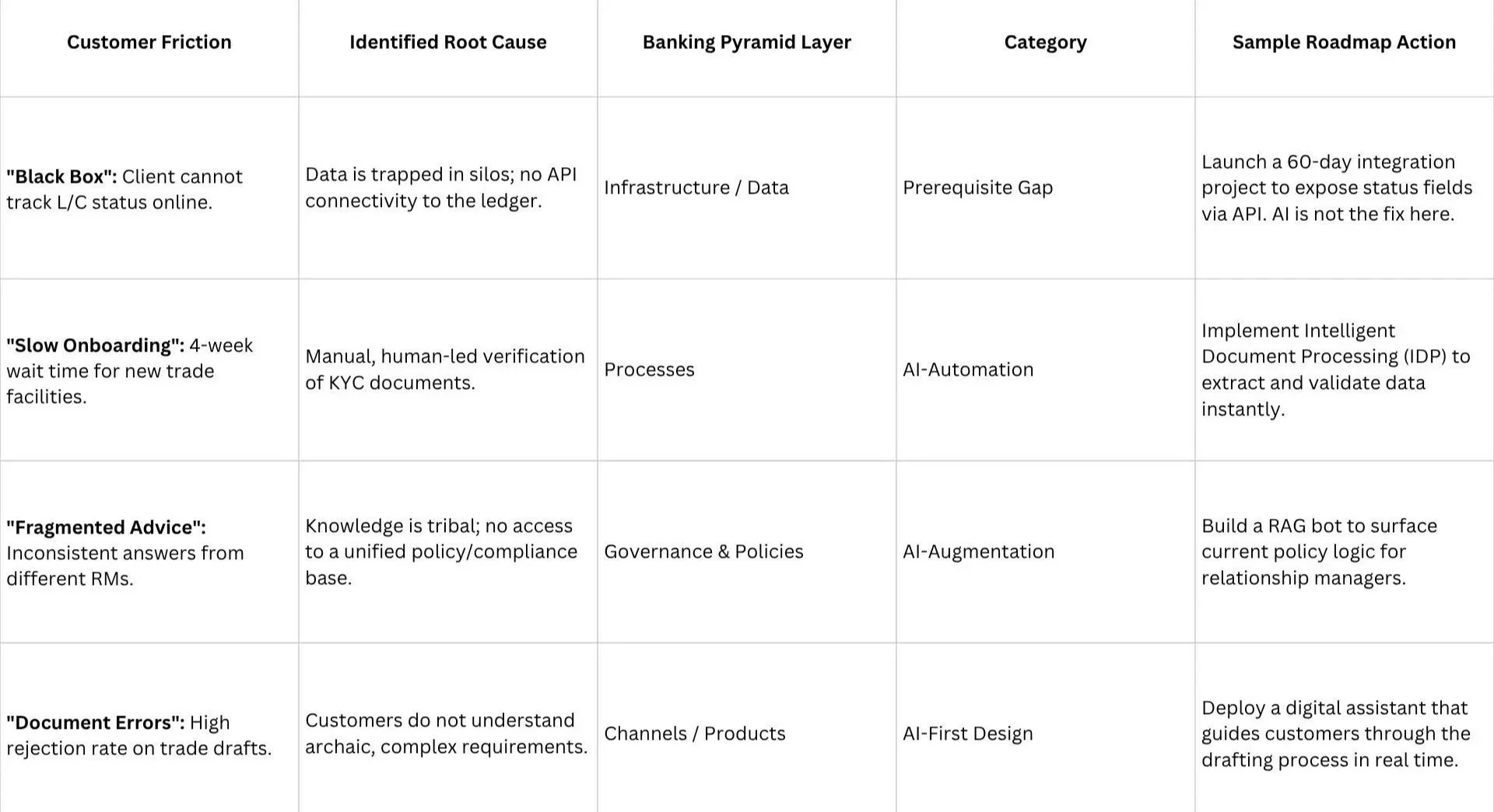
Sample list of Customer Frictions in Trade Finance and where AI can really be an enabler
Guiding Principles for Implementation
To make this framework work in practice, a few guiding principles are essential.
First, fix the plumbing before you delegate the processing to AI agents. You must remove chaos from your data, policies, and processes. Dumping advanced tools onto a messy foundation creates what we can call "ChAIotic" results: chaos multiplied by artificial intelligence.
Second, start with deterministic processes before moving to probabilistic ones. Risk and compliance officers will never accept an autonomous, probabilistic black box on day one. Begin with deterministic, rules-based automation for structured documents like standard bills of lading, then gradually mature into probabilistic reasoning as trust and guardrails solidify.
Finally, address the human element. Bankers worry that automation threatens their jobs. In reality, trade finance professionals are currently trapped acting as glorified data-entry clerks and document-checkers. AI rescues them from repetitive paperwork, shifting their focus toward risk mitigation, structuring, and high-value client relationships.
Solving the Growth Puzzle
When efficiency initiatives fail, banks usually respond by cutting costs or freezing hiring. But operational efficiency without a growth strategy is just a slow decline.
When you successfully implement the first phase of AI transformation, a significant amount of human bandwidth opens up across front-office and back-office teams. The processing backlogs clear out.
With that newly recovered capacity, your team can finally tackle the growth initiatives that always sat on the shelf: launching new trade products, expanding into adjacent customer segments, and capturing regional supply chain flows. You achieve revenue growth without needing to scale headcount linearly with every new transaction volume.
That is how you strike two mangoes with a single stone. Fix the operational plumbing, let intelligent systems handle the mechanical burden, and free your people to grow the business.
“I became a father of two before we closed that bank deal,” a bank-tech sales leader once joked.
It All Begins Here
Author
Venkat Ramaswamy
Transformation Success Partner & Founder, Atocha Consulting
Why bank-tech provider sales cycles with banks feel endless, and what to do about it
Bank-tech providers often complain that the sales cycles are too long. Yes, they are often right, and the reason mostly is that banks are often at a completely different stage of their internal journey than the vendor standing in front of them assumes.
The story repeats itself until it doesn’t: A bank-tech provider arrives with a sophisticated, well-built solution. The bank's team is genuinely impressed. And then, crickets. The discussions stall, the champion goes quiet, and six months later the bank-tech provider is told "we're not quite ready yet."
Not ready yet is not a brush-off. It's a precise description of where the bank actually is.
There are four stages every bank travels through before a transformation decision gets made.
Ambition: The bank defines its why. What are we trying to achieve? What does success look like in three years? Without a clear, agreed ambition, nothing that follows sticks.
Foundation: The bank builds its structural readiness. What infrastructure, data quality, operating model alignment, and governance guardrails must be established before we can support change? These realities must be secured honestly before moving forward.
Execution: The bank operationalizes its how. Capabilities are built, bought, or partnered for. Vendor conversations become genuinely productive here because the bank knows precisely how the pieces fit into its architecture.
Acceleration: The bank scales at speed. Contracts are signed, implementation moves rapidly, and the organization transitions into full production value.
Think of it like climbing Everest. The climbing company, your bank-tech provider, can only take you to the summit. But you have to want to climb first (Ambition). Then you have to secure your base camp and build your structural readiness (Foundation). Then you have to deploy your climbing plan (Execution). Only then does the rapid ascent begin (Acceleration).
The contract gets signed at base camp. Not before.
For bank-tech providers: the question that changes everything
Most vendor conversations start with a product demonstration. The bank-tech provider shows what the solution can do. The bank nods. Everyone agrees it's impressive. And then the mismatch begins, because the bank-tech provider is presenting an Acceleration-stage solution to a bank that's still working through its Ambition or Foundation stage.
The most valuable thing a bank-tech provider can do in a first bank conversation is ask one question before opening a single slide:
"Where are you in your transformation journey, and what foundation are you currently building or shoring up right now?"
This will help in genuinely understanding which stage the bank is at and calibrating everything that follows accordingly.
A bank at Ambition stage needs thought partnership, not a product demo.
A bank at Foundation stage needs frameworks and structural architecture design, not a features list.
A bank at Execution stage is ready to evaluate vendors seriously.
A bank at Acceleration stage is ready to sign.
Showing up at the right stage, with the right conversation, is the single biggest lever on sales cycle length. The cycle isn't long because banks are slow. It's long because most vendor conversations happen at the wrong stage.
For bankers: the question worth asking yourselves
If you're leading a Trade Finance transformation, or trying to, it's worth being honest about which stage you're actually at, not which stage you'd like to be at.
The most common pattern I see: a bank believes it's at Execution stage, evaluating vendors and running RFPs, when it's actually still struggling at the Foundation stage. The ambition hasn't been fully tied to operational constraints. The operating model question hasn't been resolved.
The result is a vendor selection process that produces a contract and an implementation that struggles because the foundation wasn't solid when the climb began.
The diagnostic question is simple: Can your leadership team write one sentence describing your AI ambition for Trade Finance, and does your current operational infrastructure safely support it?
If the answer is no, you're still working on your foundation. That's not a failure. It's vital information. And it's the right place to spend your energy before the vendor conversations begin.
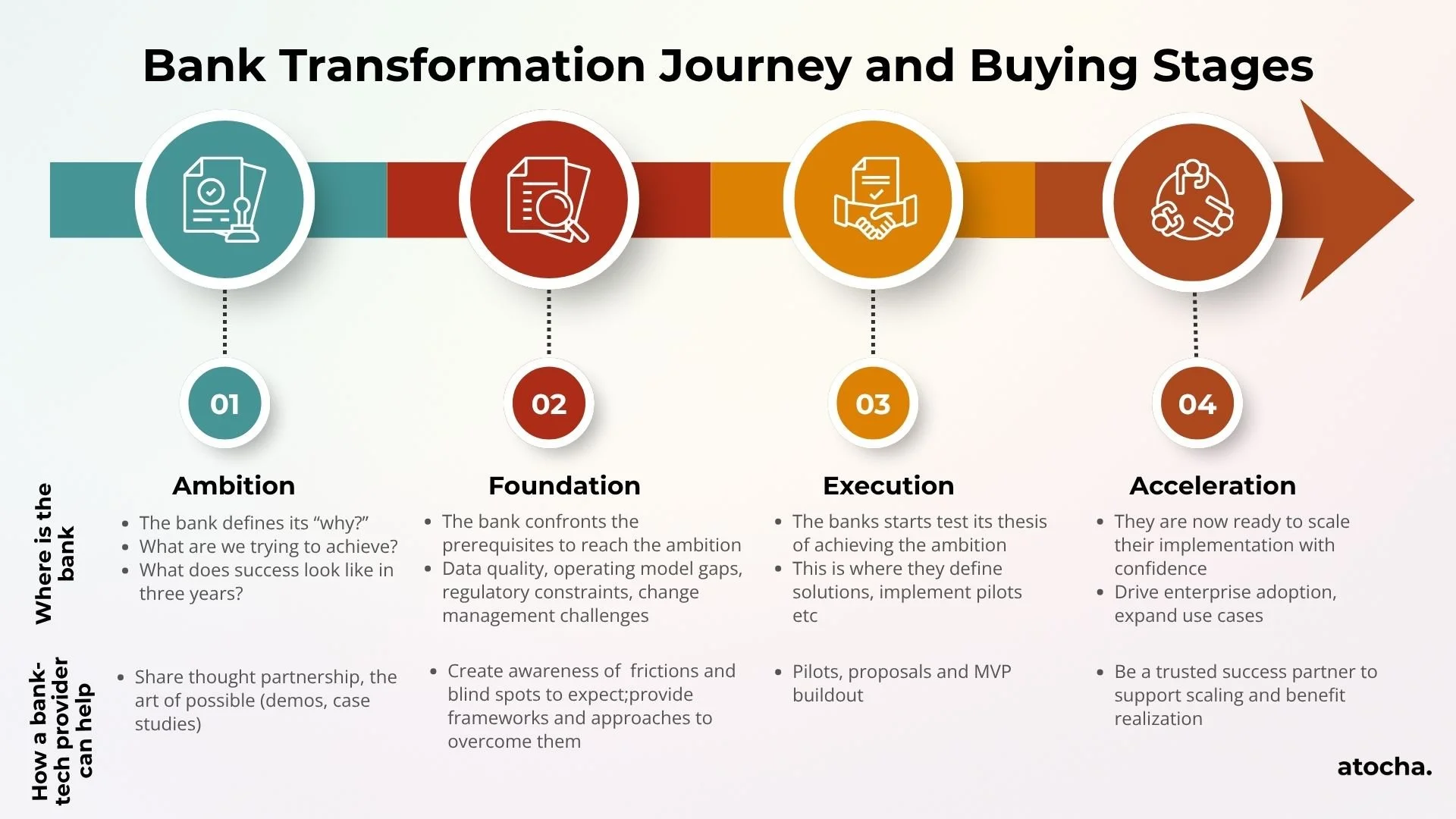
Stages in a Bank’s Transformation Journey and Buying Decisions

"Where the Heck Is My Trade Finance Transaction?"
It All Begins Here
Author
Venkat Ramaswamy
Transformation Success Partner & Founder, Atocha Consulting

The gap between your current operational reality and your strategic destination is bridged or blocked by customer experience.
The corporate treasurer sits at their desk, staring at a screen. Three days ago, they submitted a Letter of Credit (LC) issuance request. They’ve heard nothing. They send a polite email to their relationship manager. Two hours later, a reply arrives: "I’ll check with the team and get back to you."
The treasurer sighs. They’ve heard this before. In their mind, the bank is either disorganized, incompetent, or simply doesn't value their business.
But here is the twist: The bank isn’t being difficult. The bank is just as confused as the client.
Behind the scenes, there is no conspiracy to delay the trade. There is only a series of "invisible handoffs" - moments where a transaction passes between people, systems, and teams, and where accountability, visibility, and momentum quietly disappear.
1. The Client’s Experience
To the corporate treasurer, the bank is a single entity. They submit an application, and they expect a result. Instead, they experience a black box.
When a trade finance transaction stalls, the client doesn't just feel the delay; they feel the lack of transparency. It’s the silence after submission. It’s the unexplained, fragmented requests for information, “Can you send us the original commercial invoice?' followed by 'Actually, we also need you to re-sign and re-stamp the bill of lading so it matches the invoice exactly”, that suggest the bank didn’t read the application the first time.
Consider the real-world example of a major corporate client who needed to onboard a new trade channel. The bank’s internal policy insisted on a specific, dated email-based application process. Despite the client’s technological capability and clear preference for a modern interface, the bank forced them into a manual, legacy workflow "to comply with policy."
The client waited for weeks, navigated a labyrinth of back-and-forth emails, and eventually, they simply walked away. They didn't leave because the bank lacked capital; they left because the bank lacked the ability to communicate, respond, and respect their time. Every delay was a message: Your business is not our priority.
2. What’s Actually Happening Inside
If we could peel back the walls of the bank, we wouldn't see incompetence. We would see a steam engine, a powerful, functional machine that simply burns too much "coal." In this case, the coal is your client’s time and your team’s energy.
The transaction enters the bank’s ecosystem often as a PDF attached to an email. This is the 70% intake problem: that email arrives, but nobody knows it’s there until a human being manually picks it up.
Once opened, the processor begins a Herculean task of reconstruction. The application is incomplete, so they start manually drafting an email to the client, recreating the missing requirements from memory. They perform a compliance check that is half-automated, half-judgment. They earmark credit limits against a system that doesn't surface information cleanly. They file the document into a Content Management System (CMS) that wasn't designed for trade finance, meaning the next person looking for it will have to guess where it’s hidden.
Each step is reasonable in isolation. The processor is diligent. The compliance officer is thorough. But in aggregate, they produce a client experience that feels like a deliberate delay.
3. The Invisible Handoff Problem
The reason the client can’t get a clear answer on timing is not that the bank is hiding something. It’s that nobody has visibility of the full journey.
Think of the exception approval culture. A transaction hits a snag and is shunted into an "exception queue." There is no Service Level Agreement (SLA) for these queues. There is no dashboard to see how long it has been sitting there. The relationship manager’s last update was from two days ago. The processor is waiting on compliance. Compliance is working through a pile of seventeen other urgent files.
Nobody is lying. Nobody is negligent. But the client is experiencing the cumulative delay of every handoff that nobody is watching.
We often see noise-based prioritization: the high-value, quiet client whose transaction sits in a queue because a lower-value "noisy" client is escalating every five minutes. The quiet client doesn't complain; they just don't renew their contract next year. When they leave, they never appear in an incident report, they just vanish.
This is the failure of the Ops Head without a dashboard. They are managing on lagging indicators: weekly reports, escalations that arrive after the damage is done. The client’s frustration has compounded for three days before anyone with the authority to fix it even knows the transaction exists.
4. What the Journey Should Feel Like
Imagine a world where those invisible handoffs are brought into the light.
The client submits an incomplete application and receives, within minutes, a structured, specific response telling them exactly what is missing and why. The relationship manager doesn't have to promise to "check with the team", they look at a live dashboard and provide an answer in real-time.
This isn't about throwing technology at a problem; it’s about a design philosophy. It’s about transforming the bank from a collection of silos into a single, cohesive engine. When the mechanical steps are handled automatically, your team is no longer a group of data-entry clerks; they become trade finance experts, adding value where it actually matters: in risk mitigation, structuring, and client relationships.
5. The Questions That Matter
We don't need a total technology overhaul to start fixing the client experience. We need a diagnostic.
If you are a banker, a manager, or a tech provider, take these three questions into your operation tomorrow:
The Intake Visibility Test: If I look at my team’s "inbox" right now, how many transactions are sitting there that have not yet been acknowledged by a human or an automated system?
The Handoff Audit: Pick the last transaction that was delayed. Can you map the exact hour it passed from one team to another, and where it sat idle for the longest period?
The "Walk Away" Metric: If we lose a client, do we know why? Do we track how many clients stop using our trade finance services because of operational friction, rather than pricing or market conditions?
The goal isn't to be perfect. The goal is to be visible. When you make the journey visible, you take the first step toward reclaiming your client’s trust.