
How AI Transformation Can Solve Trade Finance’s Margin and Growth Puzzles at One Go!
Author: Venkat Ramaswamy
Transformation Success Partner & Founder @ Atocha Consulting

Efficiency self-funds Growth
There is a popular phrase in my mother tongue (Tamil): “Orey kallula rendu maanga”. This translates into “Strike two mangoes with a single stone”. Yes, this is the vegan version of “Strike two birds with one stone”.
Artificial intelligence is a paradigm shift of that magnitude for trade finance. Used correctly, it can strike two major goals at once: operational efficiency and business growth.
Here is the secret formula upfront, saving you a million-dollar consulting fee: Right AI investments significantly improve operational efficiency, which in turn self-funds growth. Put in practical terms: What if you can transfer 50% of current processing steps to AI so your teams gain the bandwidth to handle twice the transaction volume without adding headcount?
It sounds ambitious, but it is entirely achievable. There is a method to the madness.
The Fundamental Thinking Shift
Real transformation starts with a shift in mindset. For years, banking operations have relied on a human-led and machine-supported model. A human does the heavy lifting, and software acts as a simple utility.
Moving forward, banks must pivot to a machine-led, human-supervised model. Success depends entirely on how well an institution adopts this mindset and aligns its governance and culture to these new ways of working.
If you start your AI journey by asking, "Where can we implement AI?", you are bound to fail. Doing so puts AI on the exact same trajectory as blockchain solutions looking for a problem—a hammer looking for a nail.
Instead, a better way to start the journey is by asking two operational questions:
1. Where are our margins compressed today? This uncovers revenue leaks from friction, inefficiencies, manual workarounds, handoffs, SLA breaches, and customer complaints in daily operations.
2. What growth opportunities are we missing today? What prevents the team from capturing new market segments or launching new products?
Solving Margin Compression
Margin compression in trade finance rarely comes from bad market rates. It comes from the high cost of manual operations and friction. To fix this, look at where AI has a clear right to win. We can break operational gaps down into four layers:
· Prerequisite Gaps: Siloed systems, lack of APIs, messy data policies, and process chaos.
· AI-Automation: Routine tasks that can be automated confidently using machine intelligence.
· AI-Augmentation: Complex tasks where bankers perform smarter work enabled by co-pilot tools.
· AI-First Design: Areas with a complete capability gap where intelligent systems solve problems from scratch under strict compliance guardrails.
The following matrix maps these layers directly to common customer pain points:
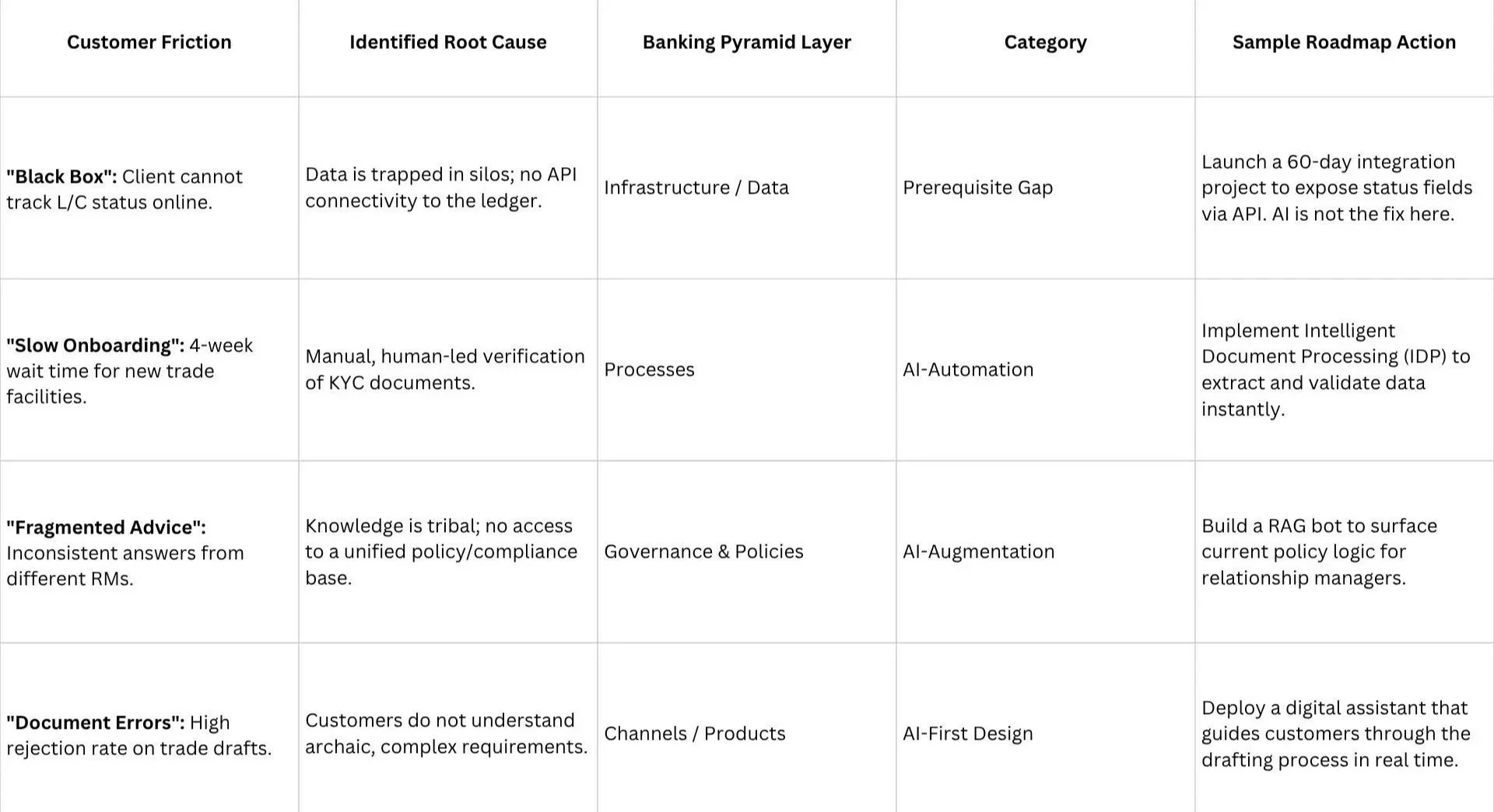
Sample list of Customer Frictions in Trade Finance and where AI can really be an enabler
Guiding Principles for Implementation
To make this framework work in practice, a few guiding principles are essential.
First, fix the plumbing before you delegate the processing to AI agents. You must remove chaos from your data, policies, and processes. Dumping advanced tools onto a messy foundation creates what we can call "ChAIotic" results: chaos multiplied by artificial intelligence.
Second, start with deterministic processes before moving to probabilistic ones. Risk and compliance officers will never accept an autonomous, probabilistic black box on day one. Begin with deterministic, rules-based automation for structured documents like standard bills of lading, then gradually mature into probabilistic reasoning as trust and guardrails solidify.
Finally, address the human element. Bankers worry that automation threatens their jobs. In reality, trade finance professionals are currently trapped acting as glorified data-entry clerks and document-checkers. AI rescues them from repetitive paperwork, shifting their focus toward risk mitigation, structuring, and high-value client relationships.
Solving the Growth Puzzle
When efficiency initiatives fail, banks usually respond by cutting costs or freezing hiring. But operational efficiency without a growth strategy is just a slow decline.
When you successfully implement the first phase of AI transformation, a significant amount of human bandwidth opens up across front-office and back-office teams. The processing backlogs clear out.
With that newly recovered capacity, your team can finally tackle the growth initiatives that always sat on the shelf: launching new trade products, expanding into adjacent customer segments, and capturing regional supply chain flows. You achieve revenue growth without needing to scale headcount linearly with every new transaction volume.
That is how you strike two mangoes with a single stone. Fix the operational plumbing, let intelligent systems handle the mechanical burden, and free your people to grow the business.
