
“I became a father of two before we closed that bank deal,” a bank-tech sales leader once joked.
Author
Venkat Ramaswamy
Transformation Success Partner & Founder, Atocha Consulting
Why bank-tech provider sales cycles with banks feel endless, and what to do about it
Bank-tech providers often complain that the sales cycles are too long. Yes, they are often right, and the reason mostly is that banks are often at a completely different stage of their internal journey than the vendor standing in front of them assumes.
The story repeats itself until it doesn’t: A bank-tech provider arrives with a sophisticated, well-built solution. The bank's team is genuinely impressed. And then, crickets. The discussions stall, the champion goes quiet, and six months later the bank-tech provider is told "we're not quite ready yet."
Not ready yet is not a brush-off. It's a precise description of where the bank actually is.
There are four stages every bank travels through before a transformation decision gets made.
Ambition: The bank defines its why. What are we trying to achieve? What does success look like in three years? Without a clear, agreed ambition, nothing that follows sticks.
Foundation: The bank builds its structural readiness. What infrastructure, data quality, operating model alignment, and governance guardrails must be established before we can support change? These realities must be secured honestly before moving forward.
Execution: The bank operationalizes its how. Capabilities are built, bought, or partnered for. Vendor conversations become genuinely productive here because the bank knows precisely how the pieces fit into its architecture.
Acceleration: The bank scales at speed. Contracts are signed, implementation moves rapidly, and the organization transitions into full production value.
Think of it like climbing Everest. The climbing company, your bank-tech provider, can only take you to the summit. But you have to want to climb first (Ambition). Then you have to secure your base camp and build your structural readiness (Foundation). Then you have to deploy your climbing plan (Execution). Only then does the rapid ascent begin (Acceleration).
The contract gets signed at base camp. Not before.
For bank-tech providers: the question that changes everything
Most vendor conversations start with a product demonstration. The bank-tech provider shows what the solution can do. The bank nods. Everyone agrees it's impressive. And then the mismatch begins, because the bank-tech provider is presenting an Acceleration-stage solution to a bank that's still working through its Ambition or Foundation stage.
The most valuable thing a bank-tech provider can do in a first bank conversation is ask one question before opening a single slide:
"Where are you in your transformation journey, and what foundation are you currently building or shoring up right now?"
This will help in genuinely understanding which stage the bank is at and calibrating everything that follows accordingly.
A bank at Ambition stage needs thought partnership, not a product demo.
A bank at Foundation stage needs frameworks and structural architecture design, not a features list.
A bank at Execution stage is ready to evaluate vendors seriously.
A bank at Acceleration stage is ready to sign.
Showing up at the right stage, with the right conversation, is the single biggest lever on sales cycle length. The cycle isn't long because banks are slow. It's long because most vendor conversations happen at the wrong stage.
For bankers: the question worth asking yourselves
If you're leading a Trade Finance transformation, or trying to, it's worth being honest about which stage you're actually at, not which stage you'd like to be at.
The most common pattern I see: a bank believes it's at Execution stage, evaluating vendors and running RFPs, when it's actually still struggling at the Foundation stage. The ambition hasn't been fully tied to operational constraints. The operating model question hasn't been resolved.
The result is a vendor selection process that produces a contract and an implementation that struggles because the foundation wasn't solid when the climb began.
The diagnostic question is simple: Can your leadership team write one sentence describing your AI ambition for Trade Finance, and does your current operational infrastructure safely support it?
If the answer is no, you're still working on your foundation. That's not a failure. It's vital information. And it's the right place to spend your energy before the vendor conversations begin.
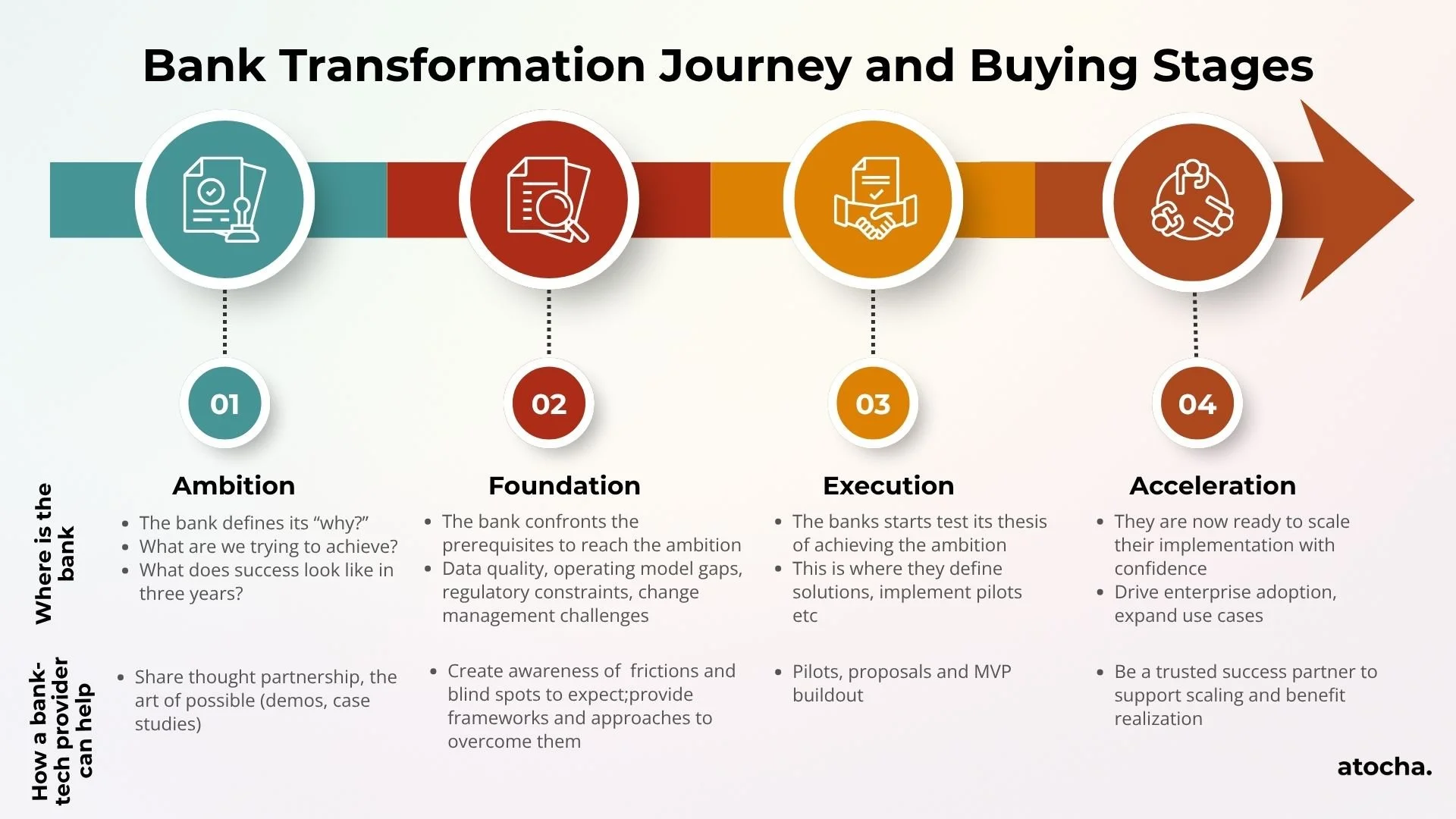
Stages in a Bank’s Transformation Journey and Buying Decisions
